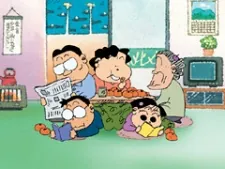
A family where nothing monumental happens, where the best moments are three minutes of your grandmother being impossible and your dad being useless in exactly the same way every episode. The show trusts that watching Nono navigate school, her annoying brother, and the small absurdities of being eight is enough to fill an hour. It is, the joy lives in recognition, not plot, in the specific texture of a life that feels lived rather than constructed. This is the comfort watch that doesn't need to earn anything because it already knows what you came for: to sit with people you don't need to worry about. By episode 30 you stop waiting for something to happen and realize something already did, you forgot what stress feels like.
Nono-chan is a third grader and the elder daughter of the Yamada family. She lives with her father Takashi, her mother Matsuko, her older brother Noboru, who attends junior high, and her grandmother, making a cheerful household of five. Each member of the family has a character of their own, and their ordinary days together are full of fun and surprises. The series is a comedic slice-of-life TV anime running 61 episodes, adapted from the manga once titled Tonari no Yamada-kun, which also inspired a 1999 feature film directed by Isao Takahata of Studio Ghibli.