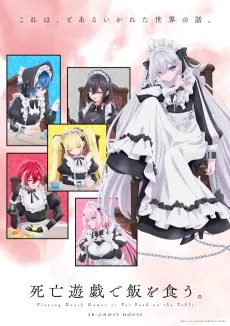
Yuki walks into death games the way other people walk into work, because the money keeps her alive, because she's good at it, because emotion is a luxury she can't afford. The show strips away the fantasy of "game show thrills" and replaces it with something colder: a kid who's learned to treat her own survival as just another problem to solve. By the time it breaks that armor, you understand exactly how much it cost her to build it in the first place.
Yuki is seventeen and has made a career out of something most people consider a death sentence: she plays death games for a living. She has lived through enough rounds to know that staying alive comes down to calculation rather than luck, and that a single mistake ends everything. One day she wakes in a lavish bed inside an unfamiliar mansion called the Ghost House, dressed as a maid. Five other girls in identical uniforms are there with her, and the only way out is through a series of lethal traps involving blowguns, buzz saws, locked rooms and weapons. The others are terrified, but for Yuki this is simply work. Still, where any room can become a grave, even her experience is no guarantee. Based on a light novel series, this psychological thriller mixes action, drama and mystery.
WHERE TO WATCH
Streaming SHIBOYUGI: Playing Death Games to Put Food on the Table legally, as of the last catalog refresh. Availability changes by region.
CrunchyrollNetflixYouTubeiQ