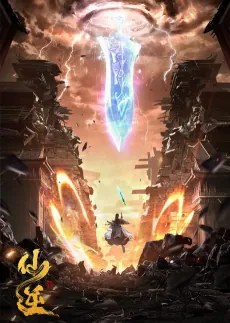
Season two stops being a cultivation school story and starts collecting on everything the first one set up. Zhang Xiaofan walked out of a burned village, sat at the bottom of Big Bamboo Peak with no talent worth mentioning, then won the Seven Meridians Tournament anyway, and the show has spent all that time quietly loading the gun. Lu Xueqi and Biyao are both still there, both still standing on opposite sides of a line he refuses to draw, and the Kongsang trip made that impossible to keep pretending about. The donghua's strength has always been the stillness between the sword flashes, the Qingyun Sect's righteousness starting to look less like virtue and more like policy. If you came for wuxia spectacle you get it, but what sticks is a kid who never asked to be anyone, holding a stick he doesn't fully understand, being asked to choose.
Ten years after the great war between good and evil, Zhang Xiaofan now goes by Gui Li and fights through infighting inside the demonic sect. When a rare treasure surfaces in the Death Swamp, rival forces clash over it, and Gui Li crosses paths with Lu Xueqi again, their mix of love and hatred growing more tangled. Looking into the vanishing of his subordinates at Fenxiang Valley, he frees Xiao Bai, a nine-tailed celestial fox, and picks up leads on an ancient witch clan. Surviving one brush with death after another, he wins over a powerful spirit-summoning sorcerer who agrees to try healing Bi Yao, the goal he has pursued for a decade. The second season of Zhu Xian is a 26-episode action fantasy adventure.
WHERE TO WATCH
Streaming Zhu Xian 2 legally, as of the last catalog refresh. Availability changes by region.
Tencent Video