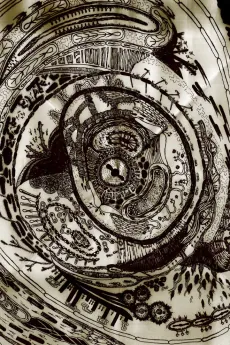
This is an experimental film about the threshold between real and drawn, where shadows become the actual subject and a hand can flicker between states without warning. The animation doesn't serve a story, it is the story, every morphing finger and abstract dissolution a sentence in its own language. You're either locked in from the first shadow or you've already left, because Eizou demands you stop looking for narrative and start looking at what movement itself can say.
Nobuhiro Aihara made this short black-and-white flicker film, which is built around shadows. Footsteps throw shadows, and the shadow of an arm stretches over a landscape of concrete, grass and flowers. As the image flickers, a finger shifts into an abstract shape. Later an actual hand shows up over the animated imagery, and the camera zooms in on drawings, hands and feet.