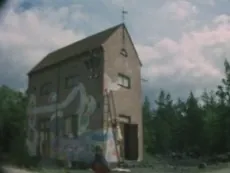
Two entirely different worlds exist in the same frame. One is Ogawa's forests and Kyoto's streets, rendered with documentary precision. The other is pure abstraction, shapes and colors that have no obligation to represent anything real. They don't conflict. They breathe together, and somewhere in that breathing is the entire point of the film. You either surrender to that language immediately or you spend ninety minutes waiting for a story that refuses to arrive. This is animation as pure visual argument, not narrative decoration.
LINE is a film that sets real scenery beside abstract animation. One setting is a stream running through the forest in Ogawa, and the other is the Kamogawa river as it passes through Kyoto. The film places these views of forest and city next to animated abstractions drawn from those same places, so each landscape and its abstract counterpart appear together.