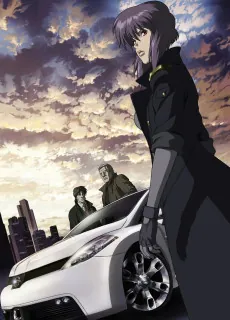
Motoko's absence is the real plot, and Togusa leading a Section 9 twice its size only amplifies how much has been lost to institutional bloat. The Puppeteer returns not as a villain to defeat but as a mirror for what happens when a society optimizes itself into homogeneity. This film moves at the speed of philosophy, not action, which means you either surrender to 90 minutes of pure cerebral tension or you don't, but if you do, you emerge understanding why Motoko had to walk away.
Two years after Motoko Kusanagi left Section 9, the unit operates under new leadership with Togusa in charge and a much larger staff. The team faces a string of tangled incidents, and its investigations point to a highly skilled hacker called the Puppeteer as the one behind all of them. Piece by piece, the separate cases begin to connect into one carefully designed crime. While pursuing the case on his own, Batou runs into Motoko, who warns him to keep his distance from the Solid State Society before leaving just as suddenly. The encounter leaves Batou wondering whether Motoko herself could be the Puppeteer. Presented as a feature-length special, the story is a science fiction mystery built around the Puppeteer's identity and the truth behind the plot.
WHERE TO WATCH
Streaming Ghost in the Shell: Stand Alone Complex - Solid State Society legally, as of the last catalog refresh. Availability changes by region.
Netflix