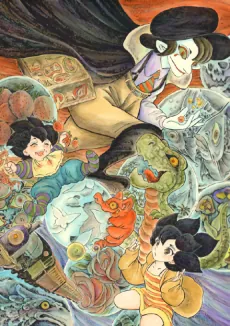
A child processing grief doesn't need magic to change her. She needs someone to sit with her in it. Dahlia arrives not to fix Daisy's loss, but to make the loneliness less absolute, and the film trusts that small act of presence is enough to remake a broken six-year-old's entire understanding of what a life can be. The yakisoba restaurant becomes less a setting than proof that meaning lives in the everyday, in the people who show up, in the nights you can't sleep but aren't sleeping alone.
When six-year-old Daisy's world collapses after losing her mother, she finds herself adrift in her aunt's care, struggling to make sense of grief too large for her small frame. Sleep won't come, and neither will comfort, until one night a figure appears at her window. Dahlia arrives without explanation, a girl who seems to exist between moments, and their connection transcends the ordinary rules of time and place. What begins as midnight visits becomes something deeper. As Daisy and Dahlia spend their days together in and around a modest yakisoba restaurant, the girl's perspective on loss and existence shifts. Dahlia offers not comfort in the traditional sense, but something stranger and more profound: a cosmic view of Daisy's life, suggesting that even small moments matter in the vastness of everything. Through their bond, Daisy begins to understand that grief doesn't erase love, and that sometimes the people we need find us exactly when we're ready to listen.