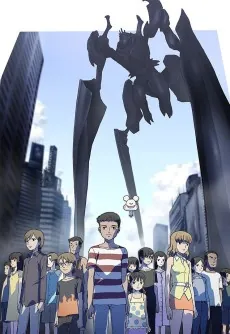
Twelve episodes in, this thing has already spent its goodwill and left you sitting there. Innocent Venus opens on a world where Hyper Hurricanes killed five billion people and the survivors got sorted into economic zones and slums, and it never once pretends that's a backdrop. Logos rule because they can, and the show is honest about what that does to the people underneath. Jo and Jin start as two soldiers running with Sana, and the series is far more interested in how that arrangement rots than in mech spectacle. The Gladiator fights land hard because they're short, ugly, and rarely make anything better. This is 2006 mecha with no triumphant final charge, just the cost, and the last stretch turns the whole thing over. Watch it in one sitting or don't bother, it doesn't reward patience so much as reward attention.
In 2010, massive hurricanes strike all over the world at once, killing five billion people and wiping out existing economies and militaries. Glaciers bury whole regions and land masses sink into the sea. Special economic zones achieve a partial recovery with the help of Powered Assist Technology, while poverty spreads through the slums outside them. The ruling class, calling itself Logos, keeps power through armed force and labels the poor who are exiled beyond the zones as Revenus. Some time later, Katsuragi Jo and Tsurasawa Jin break away from Phantom, a unit that watches the Revenus and hunts renegade Logos, and bring a mysterious girl named Sana along. Many factions want her for reasons of their own, so the pair must keep shielding her, along with the secret tied to her past. The result is a mecha sci-fi drama with a strong adventure streak.