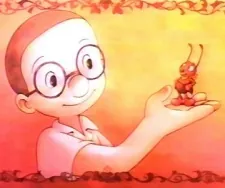
A beetle named after you teaches you why you became an artist. The film doesn't explain this through dialogue or montage, it simply shows a boy and an insect moving through nature together, the way memory actually works. By the end, you understand that Tezuka didn't invent his style because he was talented, he invented it because he couldn't stop seeing the world the way that beetle saw it. This is a museum piece that feels like a private conversation, not a museum piece at all.
Osamu and Musashi is a 1994 adventure fantasy film produced for the Tezuka Osamu Manga Museum. Through conversations between a boy named Osamu and a carabid beetle, the Osamushi from which the artist took his name, it portrays the everyday life and natural surroundings of Tezuka Osamu's childhood. Those subjects sit at the heart of the museum itself.