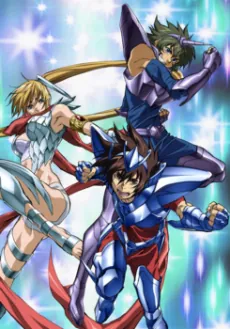
The premise promises a prequel to Saint Seiya set in 18th century Europe with three childhood friends torn apart by cosmic war. That's not what this show actually is. The Lost Canvas burns through its entire mythological setup in the first episode, then spends the rest asking what happens when you realize the person you're supposed to kill is the person you loved most. Tenma doesn't get a training arc or a power-up montage. He gets a choice that destroys him either way, and the show makes you live inside that choice for thirteen episodes. It's darker, slower, and far less interested in spectacle than the original, it moves like someone trying to talk you out of something you've already decided to do.
In 18th century Europe, 243 years before the original Saint Seiya, three childhood friends are pulled into a Holy War that Athena and Hades have waged again and again. Hot-headed but upright Tenma moves to Sanctuary to become a Saint. There he meets Sasha again and learns she is Athena reborn. Her brother Alone, a gentle boy who loves to paint, has been chosen as the body of Hades, the enemy king. Tenma goes on to become the Pegasus Saint and faces his best friend in a fierce battle. The fates of the three become tangled together in this action and adventure OVA, which serves as a prologue to the original Saint Seiya.
WHERE TO WATCH
Streaming Saint Seiya: The Lost Canvas legally, as of the last catalog refresh. Availability changes by region.
CrunchyrollNetflixCrackleYouTube