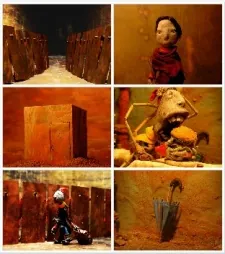
It works on you like a dream you can't shake off, quiet, unhurried, and stranger the longer you sit with it. The whole thing is built from cut paper, kiri-gami figures sliding across a Western city that never names itself, and the backdrops are stacked with borrowings from Dali, Magritte, de Chirico and Escher until the geography stops obeying you. There's no spectacle here and it doesn't want any. Just a girl walking through a place that keeps rearranging itself, and a Su Tong-Po poem threaded through it that reframes everything around it. The gut punch is the ending: she comes home completely altered and nobody can tell, and she's the only one who will ever know. Watch it twice. The second pass is when the paper stops looking like paper and starts looking like a life.
A young girl sets out for an unnamed city in the West, and her trip is as much an inner voyage as a physical one. The city is a strange, surreal dream world, packed with pieces drawn from the art of Dali, Magritte, de Chirico and Escher and rendered in cutout paper animation. Along the way she learns both the sorrow and the happiness that life holds. The journey transforms her, yet once she is back, she is the only one aware of the change. The film also includes a poem by the renowned Chinese poet Su Tong-Po. Tabi is a fantasy with a psychological bent, a meditation on private transformation told through odd, dreamlike imagery.