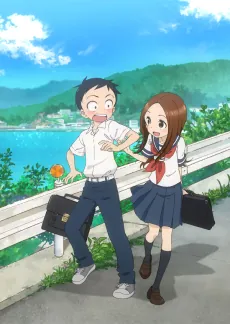
The show's entire emotional architecture rests on a girl tormenting a guy and him liking her anyway, and it somehow works because the teasing is always a conversation, never a one-way cruelty. Nagatoro's sadism has a rhythm to it; she's reading him constantly, adjusting, seeing how far she can go before something real breaks through the performance. By episode six you stop watching a bully and a victim, and you're watching two people who've figured out how to connect through deliberate friction, each one daring the other to say what they actually feel instead of hiding.
Senpai is in the school library after classes when Nagatoro, a relentless underclassman with a wicked sense of humor, decides he's the perfect target for her teasing. She shows up daily with new ways to mess with him: poking fun at his interests, mocking his shyness, pushing his buttons until his face turns red. He should hate it. He really should. Senpai, whose real name is Naoto Hachiouji, first crosses paths with first year Hayase Nagatoro while drawing his manga, and after she reads his story she refuses to call him anything but Senpai. Her antics leave him flustered and stuck going along with whatever she wants. Yet the more time they share, the more an odd friendship forms, and he starts to find that days with her can actually be fun. Why does she pick on him, and why does he tolerate it? That question sits at the center of this romantic slice-of-life comedy, adapted from Nanashi's manga.
WHERE TO WATCH
Streaming DON'T TOY WITH ME, MISS NAGATORO legally, as of the last catalog refresh. Availability changes by region.
CrunchyrollNetflixAmazon Prime VideoYouTubeiQ