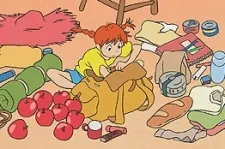
Twelve minutes in, you realize nobody has told you what you're watching and you don't care. Miyazaki throws out the rulebook: every sound effect is a human voice, mouths making the wind and the water and the footsteps, and the onomatopoeia gets painted right into the frame like a picture book someone flipped open on your lap. Fuki with her absurd overpacked rucksack, leaving an apple at a roadside Jizo just to ask permission to keep walking, is the whole Ghibli worldview in one gesture: you are a guest here, act like it. Then Nurari-Hyotan and Ushi-Oni turn up and the film treats river and shrine guardians as neighbors rather than monsters, which is somehow more unsettling and more comforting at once. It only ever played at the Mitaka museum, so almost nobody talks about it, which makes finding it feel like being handed a secret.
Fuki packs everything she needs into a big rucksack and sets out on foot to find a new home. Her journey takes her out of the traffic-choked city and onto an old, narrow path. When she comes across a stone Jizo statue, she leaves an apple as an offering and asks to be allowed through. From there she meets one odd being after another, including the river guardian Nurari-Hyotan and the shrine guardian Ushi-Oni, along with other creepy crawlies and ghostly spirits. The short fantasy adventure has very little dialogue, and every sound in it, from music to effects to spoken lines, is performed by human voices, with on-screen lettering depicting the sounds. Made to screen only at the Ghibli Museum in Mitaka, it premiered there in 2006.