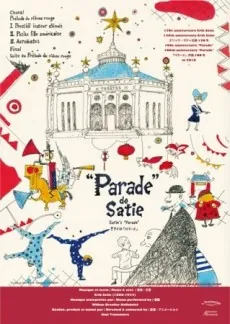
Koji Yamamura animates Satie's "Parade" like he's watching the music happen in real time, frame by frame, each image a thought the composition just had. Willem Breuker's jazz doesn't accompany the animation, it collides with it, creating something that feels like surrealism discovered its own heartbeat. This is a film for people who understand that the best animation doesn't illustrate music; it becomes another instrument in the same conversation.
A century after its premiere, Erik Satie's ballet score finds new life through animation. Koji Yamamura brings "Parade" to the screen as an animated ballet steeped in surrealism, pairing Satie's music with a performance by the Dutch jazz group Willem Breuker Kollektief. The short film presents a parade of three managers and four performers, weaving in lines drawn from Satie's own writings. Satie wrote the piece in 1916, and it was first staged in 1917 with contributions from Jean Cocteau and Pablo Picasso. Released in 2016, the film marks both the 150th anniversary of the composer's birth and the 100th anniversary of the ballet, re-creating its realist imagery in a form that reaches past reality.
WHERE TO WATCH
Streaming "Parade" de Satie legally, as of the last catalog refresh. Availability changes by region.
Vimeo