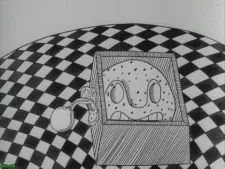
Love hits because it treats obsession like an infection spreading through sound and image, not a feeling to celebrate. The woman's repetition of a single word becomes a weapon she uses on herself, each tone shift a small violence. Yoji Kuri made something that looks like nothing else from 1963, or now, because he refused to let the audience sit safely outside her desperation. The narrative will confuse you if you expect plot. What remains is the experience of watching someone dissolve into a single emotion, frame by frame, until you can't tell if you're witnessing love or its complete opposite.
A short experimental film from 1963 by Yoji Kuri, a well-known Japanese independent animator. A ravenous woman pursues a ragged, worn-out man through bleak, estranged landscapes, saying the word 'ai', Japanese for love, over and over. She tries to tie him down with a chain, without success, and the pursuit never stops. The film offers a biting, psychological take on romantic love.