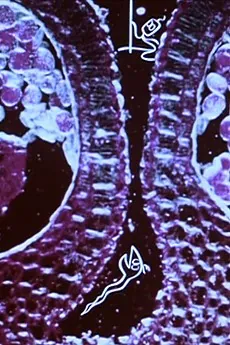
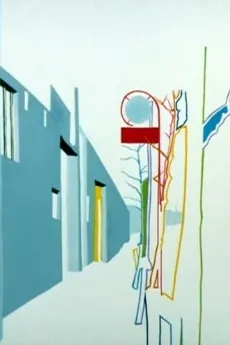
The animation isn't pretty in the expected way; it's precise, minimal, unsettling. Nakamura's score doesn't accompany what you're watching, it is what you're watching, the sound pulling meaning from abstract lines that refuse to settle into anything safe or comfortable. This is a film that trusts you to sit with discomfort, to find philosophy in the space between a brushstroke and a note, to understand that sometimes the deepest ideas move through your body before they reach your brain.
A man sits alone in a chair, spinning. The world blurs around him as he rotates faster and faster, trapped in a motion that feels both voluntary and inescapable. Reality fractures through delicate, minimalist animation that transforms simple line work into something deeply unsettling. Each rotation peels away another layer of his consciousness, revealing fragmented thoughts and fractured perceptions beneath. The spinning becomes a meditation on control and chaos, on the thin line between choice and compulsion. As the visual world warps and distorts around his fixed position, questions emerge: Is he moving or is everything else? Does he want to stop, or has he forgotten how? Nakamura Shigenobu's score wraps around the imagery like a living thing, amplifying the psychological pressure until abstraction and reality blur into something altogether stranger. This isn't narrative cinema. It's a descent into a mental state made visceral through pure animation craft. Viewers drawn to experimental work that prioritizes mood and psychological discomfort over plot will find something genuinely disorienting here.