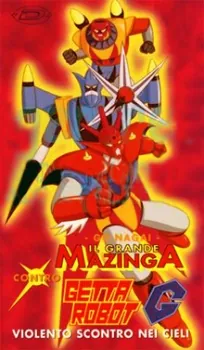
Nobody talks about this one. That needs to stop. Two of Go Nagai's titans collide in a 1975 fever dream where the plot barely exists because it doesn't need to, what matters is watching Mazinger Z's successor and Getter Robo G tear through the same screen at the same time, each one convinced it's the only robot that matters. The movie understands that a crossover lives or dies on whether you believe these machines could actually fight each other, and it commits to that belief with the kind of unhinged energy that only happens when a creator gets bored with restraint. You watch this now and realize why kids in 1975 never forgot it: this is what happens when you have two flagship robots, one director, and zero budget constraints left to burn.
Great Mazinger vs. Getter Robo G: Kuuchuu Dai-Gekitotsu is a 1975 crossover movie from Go Nagai that pits Great Mazinger against Getter Robo G. It is a single feature built on giant robot action with a science fiction backdrop. The film comes after an earlier team-up, Great Mazinger tai Getter Robo, in which the Science Fortress Laboratory and the Saotome Institute had to drop their rivalry to defeat a space monster attacking Earth.