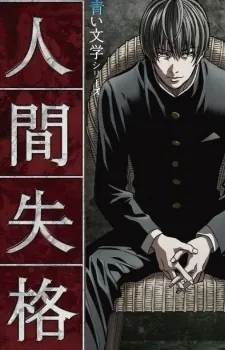
Dazai's despair doesn't perform for the screen, it suffocates you. The film strips away everything except the mathematics of a man destroying himself, frame by frame, with Obata's illustrations made flesh and Masato Sakai's voice narrating the autopsy of a human being already dead inside. You watch someone try to disappear while still breathing, and the film makes that invisible agony the only thing that matters. This is not entertainment. It is an anatomy lesson in what it costs to live when you cannot find a reason to.
Yozo Oba is a troubled, isolated man who hides behind a cheerful act while sliding into alcoholism and drug abuse. The film is a compilation that re-edits the four No Longer Human episodes of Madhouse's Aoi Bungaku Series anime, adapted from Osamu Dazai's classic novel. The character designs draw on the work of Takeshi Obata, and this director's cut adds new guiding footage narrated by Masato Sakai. The result is a psychological drama about one man's decline.